- Time neededHalf day
- MapOpen map ↗
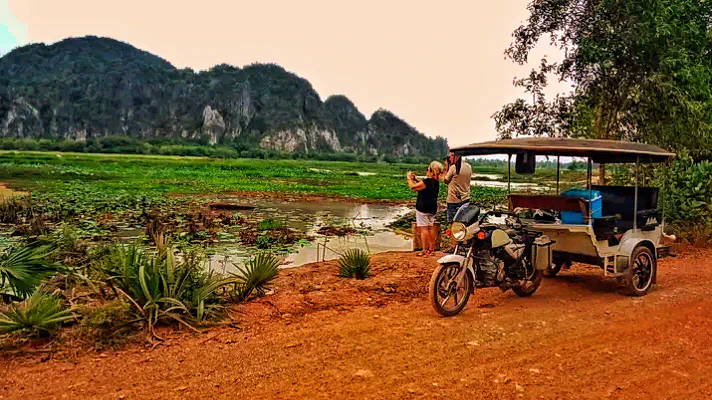
East of Kampot, limestone hills rise above the rice fields. Their caves shelter shrines and temples, including a small brick sanctuary. You can visit the nearer caves on a countryside trip, or head further east to Kampong Trach.
Phnom Chhnork
A flight of steps leads up the hill at Phnom Chhnork to a limestone cave. Inside is a small brick Hindu sanctuary, with stalactites hanging above it. Some of the rock formations resemble animals.
The cave was a Shaiva site before the Angkor period, and the age of the brick sanctuary itself is uncertain. Inside the shrine, water once dripped from a stalactite onto a small linga, a sacred symbol of Shiva.
You can visit Phnom Chhnork on a countryside trip from Kampot, along with a pepper farm.
Phnom Kbal Romeas
Phnom Kbal Romeas is another limestone hill near Kampot, with caves and places of worship. Some passages are less straightforward to explore; a local guide can help you find your way and judge which ones are suitable.
People were using this hill thousands of years before the cave temples were built. Deposits in the Kbal Romeas caves have been dated to around the fourth millennium BC.
Kampong Trach
Beyond Kep, the hills around Kampong Trach have several caves. One has a collapsed roof, with a patch of jungle growing inside; another has a pool where you can swim. The roads between the hills pass through villages and rice fields, making this a good full-day trip from Kampot.