See & Do · Travel guide
Kampot Salt Fields
Shallow salt pans, mirror-light at sunrise, and one of Kampot's most striking working landscapes.
- Time neededHalf day
- MapOpen map ↗
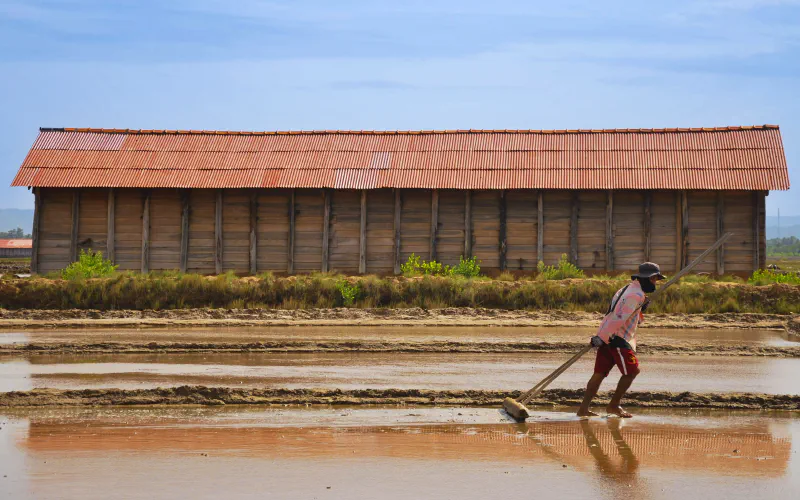
The salt fields are one of the most picturesque scenes in Kampot. Standing in the reflective pools, salt workers rake the salt into white piles, and with the clouds reflected in the water, it looks like they’re gathering clouds. They then collect the salt into hand-made traditional baskets and carry it into storage barns. The fields are also a popular spot for local birds that come to catch fish in the shallow pools.
How the salt is made
Seawater is brought into shallow pans and left in the sun. As the water evaporates, the remaining brine passes through a series of pans until salt crystals form. Workers then rake the salt together for collection.
A little history
By 1949, Kampot’s salt fields were producing around 3,000 tonnes a year, about a tenth of the salt consumed in Cambodia. Three years later, Kampot salt-makers formed a cooperative to store and sell their salt together.
Under the Khmer Rouge, the salt fields became state worksites where people were forced to work in harsh conditions. Salt production remained under state control in the years that followed. In the mid-1980s, the state allowed local people to produce salt privately again.
Help support the farmers and their families
Most visitors stop at the roadside for a few photos. If you’d like a more immersive experience, meeting the farmers, visiting their villages and helping to support programs that improve their lives, you might be interested in the half-day Salt Field Community Tour. Twenty percent of the profits go back to the community through the Chumkriel Language School.